Is Your AC Ready for 115°F? What to Check Before It Fails
Las Vegas summers are unforgiving. Here's what to inspect on your AC system before peak heat arrives — and when to call for professional service.
By the time your AC fails in Las Vegas, it's already too late to plan. When outdoor temperatures climb past 110°F, emergency service queues fill within hours, replacement parts take days to source, and your home or business becomes genuinely dangerous. The window to get ahead of that is right now — before the peak of summer, not in the middle of it.Here's what to check on your system before the heat becomes unmanageable.
1. Test the system before you need it
Run your air conditioner on a mild day before temperatures spike. Set the thermostat 5 degrees below the current indoor temperature and let it run for 15–20 minutes. What you're looking for: does the air coming from the vents feel cold? Does the system cycle on and off normally, or does it run continuously without reaching your setpoint? Either of those last two behaviors signals a problem worth addressing now.If the system hasn't been run in months — common after a Las Vegas winter — the first start of summer is often when latent issues surface.
2. Inspect your air filter
A clogged filter is the single most common cause of preventable AC failures in the desert. Las Vegas air carries fine particulate matter year-round, and during high-wind events that load accelerates. In summer, a clogged filter restricts airflow across the evaporator coil, which causes it to freeze — counterintuitively, in 110°F heat, your coil can ice over completely and stop cooling altogether.Check your filter now. If it's gray, discolored, or hasn't been changed in more than 60 days, replace it before the heat peaks.
3. Look at the outdoor unit
Your condenser unit (the large box outside) is responsible for expelling heat from your home. In Las Vegas, that unit runs in direct sun at ambient temperatures that already exceed 105°F. Clear at least 18 inches of clearance around all sides. Remove any debris, overgrown shrubs, or anything that restricts airflow. Check that the unit is level; settling can cause refrigerant to pool and reduce efficiency. If the fins on the outside of the condenser are bent or clogged with dirt, airflow is compromised. A technician can straighten bent fins and clean the coil — this is part of what we do on a standard tune-up.
4. Listen for sounds that shouldn't be there
A healthy air conditioner is relatively quiet: the hum of the compressor, the sound of air moving through vents. Sounds that warrant attention include: grinding or screeching (often a failing motor bearing), clicking at startup that doesn't resolve within a few seconds (electrical issue), banging or rattling (loose component), or hissing (possible refrigerant leak). Any of these warrants a service call before the unit fails completely.
5. Check your refrigerant charge — but don't try to do it yourself!
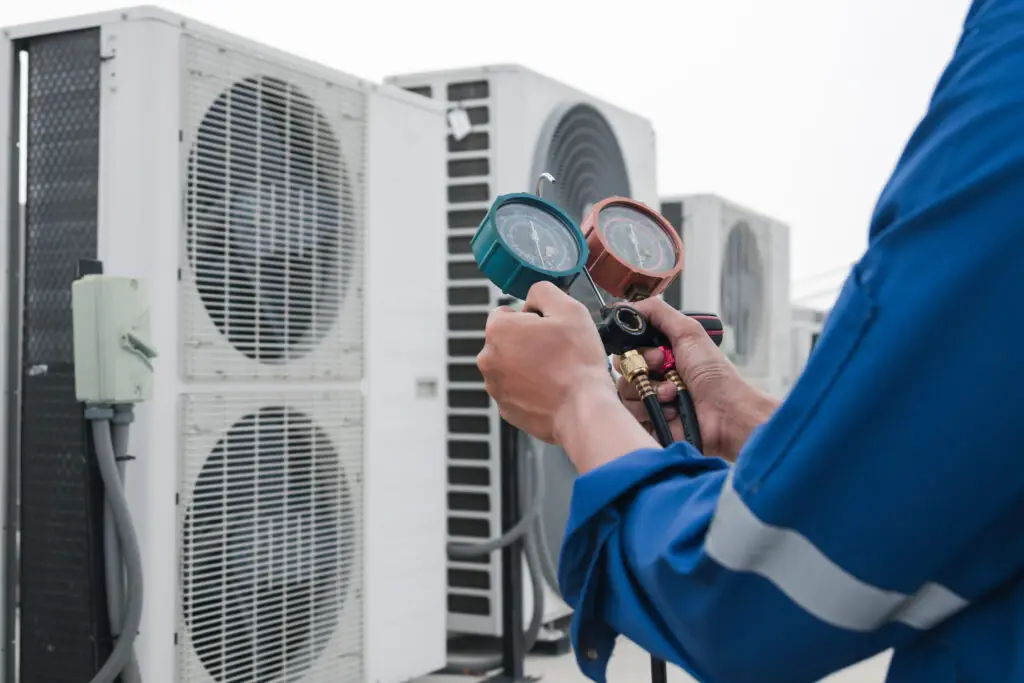
Low refrigerant is one of the most common causes of poor cooling in summer. It's also one of the things you can't diagnose or fix without professional equipment. Symptoms include: the system runs constantly but doesn't cool the space, ice forming on the refrigerant lines or the coil, or a hissing or bubbling sound near the indoor unit. Refrigerant doesn't "run out" on its own. If you're low, there's a leak somewhere. A licensed technician can identify and repair the leak, then properly recharge the system.
Getting ahead of a summer AC failure takes about 30 minutes of your time and one phone call.
Getting behind it can mean days without cooling in triple-digit heat, emergency service premiums, and the stress of coordinating repairs when every HVAC company in the valley is fully booked. If your system is more than 10 years old, hasn't been serviced in the past 12 months, or is showing any of the symptoms above, schedule a tune-up now, before peak season hits!